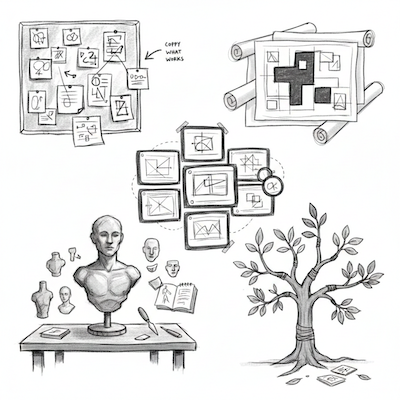
Stop Prompting. Start Training.

My twin built a full product this week.

A living directory of my principles.

  • A blur that lifts when you subscribe.
  • A card for each principle you can share.
  • A back-end to write and publish new ones.
  • An email system that notifies subscribers when anything changes.
  • A year-long calendar showing every time I’ve added, changed or removed a principle.
  • And a lot more…

Halfway through, I found a problem. When the page loaded, it jumped straight to an email input box. No context. No value. Just: give us your email.

I told my twin: demonstrate value first. Let the experience build before you make the ask.

It didn’t just fix the issue. It updated itself. It inferred the principle behind what I was saying and added it to its own taste file:

“Earned Friction: any gate must be earned through a value slope first. Jumping straight to the ask before delivering the experience is a trust violation. The user must feel the pull before we make the ask.”

I said fix it. It understood why. Then it kept building with that understanding.

When I announced Twin-Driven Development the most common question was how does this work?

Here’s the plain answer.

Before Twin-Driven Development…

You give an agent instructions. It executes them. Then it stops.

    Now you’re back. Deciding what comes next. Writing the next batch. You are not writing code but you are always on call. That is the gap no one has solved. Not execution. The “what next.”

    Agents can execute. They can work through any task list. They cannot refill it — until now.

    Your taste, in a file

    You answer five questions. We distill your answers into your twin.

    The loop

    From there, three things happen.

    1. Before twin, you prompt the AI. With twin, your twin prompts the AI.

    2. The AI asks your twin what to build next. Your twin answers.

    3. The AI builds. It marks it done. Then it comes back to your twin: what’s next? Your twin answers. Then it builds again.

    That’s it. Your taste in. Working products out.

    You can drop in at any point. Say something. Your twin adds it to the roadmap and updates itself with what it just learned about you.

    The compounding part

    Some people are prompting their agents. You are training your twin.

    Each interaction teaches it more. Your twin running tonight knows more about you than it did yesterday.

    Your agent’s task list runs out. Your twin keeps building.

    npx twin-cli init

    🔄

    What could your twin build tonight while you sleep?

    Be Your First Customer

    I launched Twin-Driven Development to sixty impressions and one like.

    Then started sharing in WhatsApp groups. One person played devil’s advocate.

    The tools do not work well with existing projects, they said. Fair.

    One like. One real conversation. And I kept building.

    The devil’s advocate was right about one gap: your twin couldn’t parachute into an existing project. I needed this for HeadsUp too. So I built it. One command reads your git history and codebase, writes a project memory and plans from there.

    Then I built something I hadn’t planned: you can talk to your twin while it’s building. Say what you want. It turns your words into tasks and updates itself with what it learned about how you think.

    I’ve done this before…

    With Trends.vc, I kept writing reports to force myself to learn. The research was autotelic. Six years later it had 55,000+ subscribers.

    With HeadsUp, I built competitive intelligence because I wanted such a tool and to see what web-enabled AI tools could do.

    Three products. Same pattern.

    Build something you need. Use it. Keep using it. Audience is a trailing indicator. Your own usage is the leading one.

    The founder who needs external traction to stay motivated will not survive long enough to find it. The founder who uses their product every day has already won the first game: staying in it.

    🛠️

    What would you keep building even if no one noticed?

    High Output, Hidden Risk

    I run my life on the Theory of Constraints. Find the bottleneck. Fix it. Find the next one.

    It works. I have solved bottleneck after bottleneck. Publishing cadence, sleep, demand generation, experiments. Each one unlocked the next level.

    But something else has been building while I was focused on throughput.

    Risk.

    I keep leaving things behind. My phone at a restaurant last week. My bag at a park this morning. No catastrophe yet. I’m still producing. Still shipping. My throughput has not dropped.

    Nowhere does ToC say: watch for risk that is accumulating outside the constraint.

    You can have high throughput, solved bottlenecks, met necessary conditions and growing exposure to catastrophic loss. The scoreboard looks good. Underneath, risk is accumulating.

    Think of 2008. The banks kept maximizing throughput. Incentives rewarded it. It had no category. It was invisible until it was everything.

    I do not have an answer yet. But I think the question matters.

    ⚠️

    What risk is accumulating in your life while you focus on throughput?

    Twin-Driven Development

    I tried out Ralph Loops (by Geoffrey Huntley). You give an agent a list of features and it picks a feature, builds it, picks the next. No input required. Until the list runs out.

    Yesterday, I read about a developer who used to sleep 7 to 8 hours. Now he is up at 5am feeding his agents. Not because a boss told him to. Because the agents are waiting.

    When the queue is done, the agent has no idea what to do next. It stops and waits for you.

    I created Twin-Driven Development to fix this.

    • Old TDD meant write the tests first.
    • New TDD means build your twin first.

    A .twin file is the .env for your taste.

    Your .twin knows how you think:

    • What do you do when two options look equal?
    • What do you ship first and what can wait?
    • How do you think about trade-offs?
    • What does “done” look like to you?
    • What do you refuse to build?

    Your twin keeps building. You are no longer the bottleneck.

    twin-cli ships with everything you need: init to build your twin, plan to build and extend your roadmap, build to let your twin execute it.

    Pass –loop and it builds, plans what comes next and builds again.

    For as long as you want.

    Not human in the loop. Twin in the loop.

    mkdir habit-app && cd habit-app
    npx twin-cli init   # how you think, in a file
    npx twin-cli plan   # your twin extends your roadmap
    npx twin-cli build  # your twin builds it

    Run plan and your twin extends your roadmap.

    Run build and your twin builds those stories.

    You can run plan and build manually in cycles, staying in control of each step.

    Or pass --loop and your twin builds, plans what comes next, then builds again.

    Start with a few user stories before you let it loop.

    npx twin-cli build        # your twin builds the current stories
    npx twin-cli build --loop # your twin builds and keeps going
    npx twin-cli build --loop --stories 5 # your twin stops after 5 stories
    npx twin-cli build --loop --minutes 30  # your twin stops after 30 mins

    You do not have to keep re-inserting yourself with Twin-Driven Development. Or waking up at 5am.

    As I write this, my twin is building a living directory for me. Seven years ago I published 100 Rules to Live By. Now my twin is building an interactive app with the current version of my rules.

    Dru.twin built a Git style log that tracks each principle like a code change, with a history of what was added, reworded and removed. Now it’s working on a principle randomizer that shows a different rule on each visit. I may have gotten there eventually. My twin didn’t wait.

    And it keeps going. Each loop, the product improves.

    Build your twin. Stop being the ceiling on your own product.

    npx twin-cli init

    👥

    What would your twin ship that you keep putting off?

    Background Businesses

    I have run Trends.vc for six years. The product only works if you do.

    For people to get value from it, they have to do something. Read the reports. Join masterminds. Show up to standups. Engage with the community. The value requires their participation.

    HeadsUp is different. Once a company sets it up, the value arrives without anyone doing anything. A team gets an alert that a competitor changed their pricing. That alert works whether the team is paying attention or not. The value is delivered in the background of their work.

    That is a background business.

    Uptime monitoring works the same way. Set it up once. If your site goes down at 3 AM, you get the alert. You did not check anything. The tool delivered value while you slept.

    Insurance works the same way. You pay the premium. The coverage runs in the background. If something goes wrong, it is already there.

    A course is not a background business. You paid for it. But if you do not watch the videos and apply the material, you get nothing. A community is not a background business. You joined. But if you do not attend and engage, you get nothing.

    In a background business, the customer receives value by default. If they have to do work to extract it, that is not a background business.

    This became one of my filters for evaluating business ideas. Does the customer have to do something to get the value? It might still be a great business. But retention depends on the customer’s motivation. And motivation is unreliable.

    Once they are in, they are in. The product works whether they think about it or not.

    💤

    What is the one thing your product does for your customer while they sleep?

    How I Review a Year in One Hour

    My year end review takes an hour.

    Not because the year was simple. Because the reviews roll up.

    Each night I review the day. At the end of each week, I review those seven daily entries. At the end of the month, those weekly entries. End of the quarter, three monthly entries. End of the year, four quarterly entries. Like Russian nesting dolls. Each layer only looks at the layer below it.

    The yearly review does not require me to remember January. It requires me to read twelve documents. The monthly does not require me to remember a random Tuesday in March. It requires me to read seven entries.

    Each layer asks two questions:

    Each week, the best answers from the daily entries get force ranked. The best from the weekly reviews get rolled into monthly and force ranked again. Same all the way up. Not everything makes the cut.

    Daily takes less than five minutes. Weekly, about fifteen. Monthly, fifteen. Quarterly, thirty. The yearly, thirty to an hour.

    Experience plus reflection equals progress. But the part that surprises me each year is what rises to the top.

    In 2025, the top three “what went well” items were not buying property. Not launching HeadsUp. Not the external milestones.

    The top three were:

    1. Meditating for two hours a day again.
    2. Writing my goals on a daily basis.
    3. Using a habit tracking app again.

    The cosmetic wins never outrank the habitual ones.

    📅

    What went well for you last year?

    From Decent to Dominant

    “Use your strengths to overcome your weaknesses.”

    I heard this for years. It sounds right. It’s not easy. And the way most people interpret it, it does not work.

    Here is what they hear.

    “I’m creative, so my lack of discipline is fine.”

    Or “I’m a fast learner, so my poor follow-through won’t matter.”

    That’s not how it works. Being creative at a 7 out of 10 does not eliminate the need for discipline.

    You have to turn your strength all the way up. I mean 11 out of 10. I mean so high that the weakness becomes irrelevant. Not ignored. Not compensated for. Consumed.

    I saw this in my own habits. I had separate habits for experiments, courage challenges, cost optimization tasks and value creation work. Four distinct lanes.

    When my experiment rate hit 13 per day, courage challenges became redundant. Run 13 experiments and some are going to push you outside your comfort zone whether you plan for it or not. At 34, cost optimization became unnecessary. At that volume you are probably going to execute on things that reduce your costs directly or indirectly.

    But at 5 experiments per day I still needed all four habits. I am good at sensing what would be a good experiment and executing on it. But 5 per day is not enough to make weaknesses irrelevant. You have to go extreme. Five was not enough to weaponize.

    This is the difference between having a strength and weaponizing one. A strength at moderate volume is a nice trait.

    A strength at extreme volume is a superpower.

    You do not overcome a weakness by running your strength at moderate volume. You overcome it by cranking your strength until the weakness is consumed.

    🦹‍♀️

    What strength could consume a weakness if you went all the way with it?

    More Examples Make It Easier

    Each one of my Trends.vc Reports is packed with case studies. Sometimes nearly a hundred across a full report.

    Here is one company that applied a strategy. Here is another. Here is a third in a completely different market. The reader does not have to take my word for it.

    • One example is an outlier.
      “That worked for them. They are different from me.”
    • Three examples is a maybe.
      “Maybe it is not a fluke.”
    • Eight examples is a pattern.
      “One of these looks like my situation.”

    More makes it feel inevitable.

    The examples de-risk the opportunity. Show enough examples of something working and the argument makes itself.

    Some people pride themselves on being original. You can spend your life chasing originality and never ship anything (that works).

    Learn from what works. Remix on top of that base. Stand on the shoulders of giants.

    “Nothing is original. Steal from anywhere that resonates with inspiration or fuels your imagination. Authenticity is invaluable; originality is nonexistent.”

    Build a swipe file. Copy the mechanics. Create a purple ocean.

    🎨

    What are you trying to figure out from scratch that someone else has already solved?

    The Replay Protocol

    Each night I sit down with an A6 pocket journal.

    1. Date
    2. Five-year goal
    3. Current bottleneck
    4. Tempo score (-4 to 4)
    5. What went well
    6. What could I have improved
    7. Then I rewrite my current version of 100 rules

    The review takes about 10 minutes.

    The rewriting takes the rest. Total: 45 minutes to an hour. Friction is the feature.

    I used to think of this as a “daily review.” That name does not capture what is really happening.

    I am extracting signal from the static of the day. Don’t waste pain.

    One replay is a single data point. A week of replays is a trend. A month of replays is a trajectory.

    The replay protocol turns a day I lived through into a day I learned from. Without it, most days just pass.

    Your day already contains lessons. The replay is how you find them.

    🔁

    What would change if you spent 10 minutes replaying each day?

    The Experiment That Changed My Mornings

    For years I believed one thing about meditation:

    It had to be first.

    First thing after waking. Before tea. Before work. Before information, notifications and conversations reached me.

    I held this belief for fifteen years.

    It was not a preference. It was a law.

    I tested it before. Or thought I did. But those tests were confounded by sleep deprivation and probably other factors.

    I was doing research on how to get better sleep.

    Two things surfaced at the top:

    1. Consistent wake time. Not bedtime. Wake time is what anchors your rhythm.
    2. Morning sun.

    The first one I locked in about a month earlier. The second one surprised me.

    I heard it before. Many times. My instinct was to dismiss it again.

    But this time I caught myself. What if I tried it just for one day?

    The next morning I went to the rooftop. The goal was 15 minutes of sun.

    I ended up meditating up there. The whole session. Then I worked from the rooftop afterwards.

    I cut my operations time in half that week. I leveled up multiple habits. That first day was the most productive day of the year for me. It came with energy and clarity of thought I did not expect.

    I did it again the next day. Also productive. Also clear.

    Fifteen years of unquestioned belief.

    Two days of experimentation to break it.

    Sacred cows disguise themselves as wisdom. Sometimes they are wisdom. Conditions change. Environments change.

    What was true five years ago may not be true for you today.

    They survive because they are never questioned again.

    The antidote is uncomfortable:

    Treat long-held beliefs as hypotheses.
    Then run experiments.

    If it survives the test, it earns its place.

    ☀️

    What belief are you protecting that you have not tested in years?