Revenge Bedtime Procrastination Isn’t About Sleep. Ask Hermès.

Watch

Listen

“For every diet, there is an equal and opposite binge.”

Geneen Roth

I gave up rest days and paid for it with 3am binges.

The harder a day runs, the more I need to decompress before bed.

I know I should sleep. I stay up anyway.

This week I was researching for an essay about my late nights when a tweet stopped me.

In June 2020 a journalist named Daphne K. Lee translated a phrase from Chinese social media: revenge bedtime procrastination. People who lack control over their daytime life refuse to sleep early, to win back a sense of freedom in the late hours.

The phrase was born inside China’s “996” work culture, where the schedule runs 9am to 9pm, 6 days a week. That’s 72 hours a week.

I read the definition and it described my evenings.

The day filled up so I took the time I wanted at midnight.

In April 2020 an Hermès store in Guangzhou reopened after China’s lockdown ended. In one day it took in 19 million yuan. About 2.7 million dollars, believed to be the biggest single day any boutique in China ever recorded.

The press called it revenge spending. The urge to buy built up through months of closed stores and came out all at once when the doors opened.

Preachers’ kids carry a reputation: the strictest rules growing up, the hardest acting out after they leave home.

My mentor at my first job out of college grew up in a house where his parents didn’t allow TV and handed him books. He was wildly successful by the time I worked with him.

And now he loves TV the way I love chess.

In 1944 a scientist named Ancel Keys put 36 volunteers on half rations for 6 months to study starvation.

The men got obsessed with food. They stayed up reading cookbooks and menus. One collected more than 100 cookbooks.

When the 6 months ended, some of the men ate 7,000 to 10,000 calories a day and still said they were hungry. One needed about 3 years to feel normal around food again.

Push a want down in one place and it shows up in another.

  • “Me time” moves from the day to after midnight.
  • Spending moves from the months the stores were shut to the day they opened.
  • The hunger moves from meals to cookbooks to eating all day and still feeling hungry.

I know it’s revenge bedtime procrastination and I still stay up too late.

The habit you keep losing to at midnight usually starts at noon.

🌊

Which recurring problem could you fix at its root?
Proximity Is Power. Here’s the Math.

Watch

Listen

“Scenius stands for the intelligence and the intuition of a whole cultural scene. It is the communal form of the concept of the genius.”

Brian Eno

I went three years without earning a dollar, then made $100 in two hours.

The two hours started in a room at Atlanta Tech Village, the first mastermind I joined: a handful of founders meeting each week to say what they did, what’s next and where they’re stuck.

Trends.vc, my market research newsletter, was a few months old and the offer I sent for it got zero replies.

I wanted to wait a week and try again.

A member named Ash told me: “Pivot now. Be vulnerable. Send the message today.”

I did. The $100 came first. Much more followed from that one message.

I wrote Trends.vc in an Atlanta condo on the BeltLine, a walking and biking trail through the middle of the city.

The rent ran two to three times what the same place cost outside the city. I was paying for the environment.

Then I started nomading. Each new apartment lasted a few weeks or a few months. Countries changed too.

Spain, Turkey, Brazil, South Africa.

Each move started me over among strangers.

Each move reset the basics: where I worked, when I worked and where I trained. By the time a place felt normal I was packing again.

I call part of that stretch self-sabotage.

The same years taught me which environments I work in best.

Alfred Marshall studied how one trade clusters in one place. He wrote in 1890 that inside a cluster the secrets of the work stop being secret and hang in the air.

Economists call this agglomeration: you get more out of the same people and tools when they sit close enough to touch.

A room creates more connections than it has people.

  • 2 people: 1 connection
  • 5 people: 10 connections
  • 10 people: 45 connections

A crowd in one place produces more than the same crowd spread across a map.

Andrea del Verrocchio took in a 14-year-old apprentice named Leonardo in 1466. Perugino trained in the same Florence workshop and later taught Raphael.

Iten sits at about 8,000 feet on the edge of Kenya’s Rift Valley, a town of roughly 42,000 people, most of them farmers. Eliud Kipchoge and David Rudisha trained there. Amateurs travel there to train alongside them.

Thin air is available on any mountain.

The runners beside you each morning are what the plane ticket actually buys.

Rex Sinquefield wanted somewhere to play chess in retirement, so in 2008 he and his wife Jeanne opened a club in St. Louis. Congress named the city the Chess Capital of the United States in 2014.

About 20 grandmasters live there now, which puts one Midwestern city alongside a handful of places worldwide.

Bell Labs stretched the main corridor of its physics wing to 700 feet. Walking it meant passing chemists, metallurgists and engineers.

A crew laid 827 miles of fiber from Chicago to a data center in New Jersey in 2010. The line cost about $300 million and cut a trade order’s trip from roughly 17 milliseconds to 13.

That gap is four thousandths of a second.

Distance costs money even when no one involved is human.

Each of those places has a price.

A membership, a flight or a move buys proximity to a crowd that already exists.

Buying your way in costs less. Building a scenius yourself is the other option.

Sinquefield took it. He wanted a chess scene and paid to assemble it.

The version I built is smaller.

Sitting in a room someone else built taught me what a few sharp people nearby are worth, so I still run mastermind groups today.

🧲

What group could you join or start?

The 100x Comparison: Big City vs Small Town

Watch

Listen

“We can never do merely one thing.”

Garrett Hardin

Bill Gates spent more than a billion dollars making high schools smaller and later wrote that test scores barely moved.

His 2009 annual letter said it plainly: “Many of the small schools that we invested in did not improve students’ achievement in any significant way.”

Small schools crowded the top of the test-score tables, so his foundation funded more of them. Then Howard Wainer sorted all 1,662 in Pennsylvania and checked the bottom of the table too.

Six of the 50 best were among the 50 smallest. So were 9 of the 50 worst.

A small group’s average swings wide and the same swing put those schools at both ends.

Crime is worse in big cities, so the same reasoning is running on them now. The place is big and going wrong, so live somewhere small.

Geoffrey West and his collaborators measured how a long list of city quantities change with population.

The socioeconomic ones change together. Crime, wages, GDP and patents all rise by about 2.2 times each time the population doubles.

Roads and cables go the other way. They rise by only about 80% per doubling, so a bigger city needs less of both for each resident.

Set a town of 50,000 beside a city 100 times its size.

In the big city you need about half the road and produce about double the wages, patents and output.

People read the crime number and start looking at smaller places. I watched that reasoning spread after the numbers went around.

So take the salary and leave?

You can keep the salary. West traces a city’s high wages to the number of people packed close enough to work with each other.

Move out and you keep the wage. You stop being one of the people who produce it.

That works while the city stays full.

The patent rate stays behind too. The town also needs about twice the road for each resident, which you help pay for now.

The lower crime does come with you.

Pennsylvania’s small schools were a measurement problem.

City crime is measured and real. It rises at the same rate as the wages and the patents, so a place gives you all three together.

Working remotely separates them for one person for a while. The town still has the town’s patent rate and the town’s road cost per resident.

Lower crime, fewer patents, lower wages and more road per resident is a package you might actually want.

The number you want lowered comes in the same package as the numbers you want kept. Picking a size is the whole decision.

🏙️

Which tradeoff could you start making on purpose?

From $32 Billion to 25 Years: The Math He Skipped

Watch

Listen

“And you ask, ‘What if I fall?’ Oh but my darling, What if you fly?”

Erin Hanson

A voice cuts through the track and asks, “What if I fall?” The answer follows: “Oh but my darling, what if you fly?”

Producers keep folding those lines into the dance music I listen to.

The words come from a poem. Erin Hanson wrote it at 18 and posted it to her blog, The Poetic Underground.

The lines traveled far enough that people credit them to Peter Pan.

“What if I fall” weighs the downside. “What if you fly” weighs the upside.

Say a bet costs you $1 when it misses, pays you $10 when it hits and hits 1 time in 3. Run it 30 times and you land around $80 ahead, even though most single bets lose. Gamblers call that a positive expected value bet: the odds pay you if you keep playing.

Odds like that are reason enough to bet before you’re certain.

You control whether you take the bet. The result is out of your hands.

Sam Bankman-Fried preached that math in interview after interview: positive expected value, take the bet. He ran FTX, a crypto exchange once valued at $32 billion.

An economist once asked him about a game: 51% it doubles the world, 49% it wipes the world out, played double or nothing.

He answered that maybe you play your way into “an enormously valuable existence.”

Gamblers size bets with the Kelly Criterion, a formula that keeps a run of losses from wiping them out.

Bet above Kelly and one miss can end you. Bet below Kelly and your wins stay too small to matter.

He tweeted that he’d bet bigger than the formula recommends.

In November 2022 FTX collapsed.

Customer deposits went down with it and a judge gave him 25 years.

The $80 arrives only if you survive all 30 bets. A 50% loss takes a 100% gain to climb back. Lose it all and the game ends.

Size each bet so a miss can’t finish you. Pass on games where a single turn can. When the odds pay, go.

🪂

What idea could you test at a survivable size?

The Same Loop That Killed Sears Runs Your Nights

Watch

Listen

“Keystone habits start a process that, over time, transforms everything.”

Charles Duhigg

I stay up late to catch up on my day and the catching up puts me further behind. The clock reads close to 1am and I’m still scrolling.

The deal I made with myself was screens off by ten.

Then ten comes and goes and I keep scrolling, keep reading, keep telling myself the next thing is the last thing.

Late off the screen means late to sleep. Late to sleep means a late start the next day. A late morning eats into the afternoon and by evening I’m behind, so I reach for the screen to catch up.

And then it’s 1am again.

Each late night makes the next late night easier and the next early night harder.

In May 1935 a stock speculator named Bill Wilson paced the lobby of Akron’s Mayflower Hotel. The business trip that brought him there collapsed and the hotel bar was open.

He drank at night, woke up sick and the only cure that worked was another drink.

For years he promised to stop and broke the promise, the same way I promise myself ten and watch it slide to 1am.

He walked past the bar to a phone booth and worked through a church directory until one call led him to another alcoholic, a surgeon named Bob Smith. The two kept the break small enough to hold: stay sober one day at a time. Their meetings grew into Alcoholics Anonymous.

In 1979 the whole United States got stuck in a loop.

Inflation hit 13 percent that year: prices climbed partly because people expected them to keep climbing. Workers asked for raises to cover next year’s prices. Companies raised prices to cover the raises.

Paul Volcker took over the Federal Reserve that August and pushed the country’s interest rates to 20 percent.

  • Farmers drove tractors to Washington and blockaded the Federal Reserve building.
  • Car dealers sent coffins filled with the keys of unsold cars.
  • Builders mailed him two-by-fours.

He held the rates high for three years. Breaking my loop takes closing a laptop by ten.

By 1983 inflation was near 3 percent and the expectations ran in reverse: people planned on stable prices and the planning kept them stable.

Around 2010 Sears got stuck in the loop. It closed stores to save money, lost the shoppers who used those stores, then closed more stores to cover the lost sales. Around 3,400 stores became five.

In 2001 Jeff Bezos sketched the same loop running the other way on a napkin:

  1. Lower prices bring more customers.
  2. More customers attract more sellers.
  3. More sales spread the cost of the warehouses.
  4. Cheaper operations fund lower prices.

Step 4 restarts step 1.

The press calls what happened to Sears a doom loop. Bezos named his napkin sketch the flywheel. Same loop. The direction is the only difference.

Your credit card runs the same loop.

Pay the minimum and the interest compounds against you. Pay anything above the minimum and the direction flips: each extra dollar shrinks next month’s interest, which frees up more dollars, which shrink it faster.

My screen loop runs on the same kind of input: what time I get off.

Most nights I lose. One night I got off at ten.

The next morning started on time. That left slack in the evening and the slack made the next night easier to close.

Momentum works for whoever sets the direction.

🔁

What can you cut to get your momentum pointing in the right direction?

Patagonia’s 5-Word Policy for Getting Work Done

Watch

Listen

“Luck is preparation meeting opportunity.”

Oprah Winfrey

I skipped the work my streaks depend on and each one held.

Yvon Chouinard built Patagonia out of a blacksmith shop. He forged climbing pitons and sold them from the trunk of his car. Years later he wrote a book called Let My People Go Surfing and gave his staff a policy by the same name.

When the surf comes up, go.

Work the hours around it as long as the work still gets done. Catch the swell and come back.

When I first heard the policy, surf when the surf is good sounded to me like permission to skip the work.

It read like a trade: discipline or spontaneity, pick one. What about showing up each day? A habit streak builds your reputation with yourself: each kept day is evidence you’ll keep the next one. Skip on a whim and the evidence breaks.

This morning the policy clicked: Chouinard didn’t skip work. He moved it around the waves. Discipline or spontaneity is a trade-off that only looks real. He tunneled through it.

Habit banking is how mornings like this happen for me.

On a strong day I work past the daily minimum: an extra post, extra marketing, extra mobility work. The credit carries forward. Bank enough and the day’s work is done before the day arrives.

So I did it for the plot.

Let my people go running.

Chouinard’s people earned their waves. This morning was my wave: sun out, air cool, a day built for a run. Build the reserve and you’re free when your wave rolls in.

🏃

What reserve could you build for the chance worth dropping everything for?

How to Focus on One Thing All Day

Watch

Listen

“You can have it all. Just not all at once.”

Oprah Winfrey

For the past 170 mornings, my writing streak depended on me showing up. This morning it stood on its own. I could miss three days and keep it.

I publish one essay a day. An app I built lets me bank ahead: do tomorrow’s work today and the credit carries forward.

The cushion grew one spare post at a time.

My days used to get sliced into twenty-minute turns: writing, then a marketing block, then reading, with each context switch costing me attention. Today’s work was already done: three finished posts sat ready to publish and my other habits had credit banked. So I handed the whole day to writing.

One long block of deep work, hours in the zone, post after post.

Tomorrow the whole day can go to marketing, the day after to reading. The streaks hold: banked credit covers each habit on the days I spend deep in another.

Indie hackers fight the same drag with the calendar. Paul Graham wrote that makers need blocks of half a day at minimum: one meeting can blow a whole afternoon.

Some founders go further and alternate whole weeks, one week building, one week marketing, with the switch planned a week out.

Bill Gates gave whole weeks to pure study. Twice a year he vanished into a forest cabin for a Think Week: seven days alone with a stack of papers from his employees, a caretaker dropping off two meals a day.

The 1995 memo that turned Microsoft toward the internet came out of one.

They schedule the deep day. I check the bank.

The morning the app shows my habits banked ahead, I can hand the whole day to one thing or take the day off.

I built the bank to protect my worst days: a rough day spends savings instead of snapping the streak.

A deep day refills the bank: I finish several posts ahead of schedule and the extras cover the next rough stretch.

Habit banking makes a bad day survivable and a good day deep.

🤿

What can you get ahead of?

One Small Promise, Kept 108 Mornings in a Row

Watch

Listen

“Self-esteem is the reputation that you have with yourself.”

Naval Ravikant

One cup of tea almost broke my 108-day streak.

At ten I stop caffeine for the day. A late start meant choosing between the cup and the cutoff. I leaned toward the cup.

Before I chose, I checked the streak: 108 days.

108 mornings I said I’d stop at ten and stopped. I weighed the tea against the record and made a caffeine-free cup instead.

It was only tea.

But the cutoff comes around each day. The record is made of choices this small.

I once went to the gym at midnight to protect a 26-day running streak. A five a.m. flight and fourteen hours of travel were coming, so I did the next day’s run the night before.

Some counts guard more than tea.

In the 1940s Sister Ignatia helped run a ward for alcoholics in Akron, Ohio, alongside Dr. Bob, a co-founder of Alcoholics Anonymous. She gave each patient leaving a medallion and one instruction: to drink again, first bring the medallion back to her.

AA groups still mark sober time with chips:

  • 24 hours
  • 30 days
  • 1 year

One group counted in poker chips.

A bet is a confidence signal.

At the 2003 World Series of Poker, an accountant named Chris Moneymaker played Sammy Farha, a seasoned pro, one-on-one for the title. Moneymaker missed the cards he was chasing and pushed every chip forward anyway, holding king high, a hand that would have lost the moment the cards flipped over.

Farha held the better hand and read the bluff out loud: “You must have missed your flush draw, huh?” He folded anyway.

Moneymaker took the pot, then the title and $2.5 million.

Confidence makes good outcomes more likely.

Each promise you keep to yourself is evidence your own word is good. That record stays private.

When your habits have long streaks behind them, the confidence carries over to the rest of your life.

🫖

Which promise, kept daily, would build your confidence?

The 3% Mortgage Debate Is Really About Sleep

Watch

Listen

“What is essential is invisible to the eye.”

Antoine de Saint-Exupery

My friend paid off a three percent mortgage to sleep better. The same payoff would keep me up at night.

The math looked airtight: borrow at three percent, invest the same money at seven and you keep the four-point spread. Pay the loan off early and you hand that spread back.

On paper, paying it off is a loss.

He paid it off anyway. The monthly payment is gone.

His peace of mind fits nowhere on a spreadsheet.

Money is one type of resource. It’s quantifiable. On the stack of resources, it sits at the bottom: awareness, attention, energy and time all rank above it.

A dollar lost can be earned back. An hour of attention is spent once.

Measure a choice in dollars alone and good choices look like mistakes.

A lottery ticket loses money on average. The ticket costs two dollars and, across all the tickets sold, the prizes pay back less than the players put in. Economists call that negative expected value: play long enough and losing is guaranteed.

Judged in dollars, each ticket you buy is a mistake.

For those same two dollars, the ticket also buys you a week of imagining a different life.

When you’re poor, you get judged for this the hardest. From the outside your short-term choices look like bad math.

Terry Pratchett wrote the rebuttal into a novel. His watchman, Sam Vimes, earns thirty-eight dollars a month.

Good boots cost fifty dollars and last ten years.

Cheap boots cost ten and leak after a season or two, so a man with ten dollars to spare spends a hundred on boots over the decade and still ends up with wet feet.

Buy right or buy twice.

Vimes can see that math and still buys cheap. Fifty dollars in hand has to cover this month before it ever covers the decade.

The spreadsheet sees a bad boot trade. Vimes is weighing the columns it left out.

When money is tight, covering this month beats winning the decade.

The sociologist William Bruce Cameron put it plainly: “Not everything that can be counted counts. Not everything that counts can be counted.”

Before you call a choice irrational, ask what the person making it can see that you can’t.

😴

Where would you take a loss on paper for a win in energy, attention or sleep?

Chase Risk Before It Chases You

Watch

Listen

“And the trouble is, if you don’t risk anything, you risk even more.”

Erica Jong

You can pay for a risk you never take. One email cost me a month of dread and thirty minutes of work.

It sat in my inbox while I imagined what was waiting inside.

Each day I chose another day of low-grade dread over a few minutes of discomfort. The unknown was the scary part. When I finally opened the email, the unknown shrank to a small, known task and the dread was gone before I hit send.

A $100 bill hidden under a mattress feels safe. The bill sits still and buys a little less each year. Hide one in 2000 and it buys about half of what it bought then.

In 1975 a Kodak engineer named Steve Sasson built the first digital camera. Management looked at it and said: “That’s cute, but don’t tell anyone about it.” Film made the money and film felt safe, so the digital camera sat shelved for twenty years.

Kodak filed for bankruptcy in 2012.

Netflix’s founders flew to Dallas in 2000 and offered Blockbuster the whole company for $50 million. Blockbuster ran thousands of stores. Netflix mailed DVDs from a website. The CEO struggled not to laugh and Blockbuster stayed put.

It filed for bankruptcy in 2010.

Standing still feels safe. The bet underneath: prices hold, the market doesn’t change.

“The only lasting truth,” Octavia Butler wrote, “is Change.” Standing still is a different type of risk: the type you take without choosing it. Of course, “not to decide is to decide,” as the theologian Harvey Cox wrote.

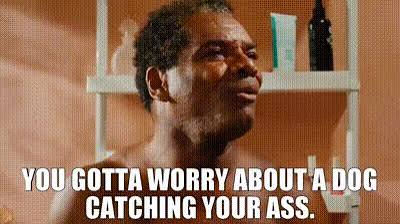
The movie Friday put the same idea in different words back in 1995. Craig’s father catches stray dogs for a living and wants Craig, fresh off losing his job, to apply. Craig tells him he ain’t trying to be no dog catcher. His father fires back:

“If you ain’t got nothing on the table, you ain’t gotta worry about catching a dog. You gotta worry about a dog catching your ass.”

Craig’s father in the movie Friday, mid-scene: “you gotta worry about a dog catching your ass”

To keep a dog from catching my ass, I run courage challenges each day: one act that takes nerve.

  • The sales ask
  • The hard conversation I’ve been ducking
  • Pushing a run further than I’ve tried before

I chase risk before it can chase me.

Taking no risk is taking a risk. One you choose by not choosing.

🎲

What’s one move you could make before the world makes it for you?